

Preparing for a Healthy School Year 2026

Updated: Oct 14
By The Aafiyah Project
New notebooks. Fresh uniforms. School supplies. Lunch boxes. Transportation plans.
For families with school-aged children, the end of summer comes with a long list of things to prepare. Here in Prince George's County, students returned to classrooms on Tuesday, August 25, for the 2026–2027 school year.
A few weeks in, many of those items have been checked off the list. But preparing children for school has always been about more than what goes into their backpacks.
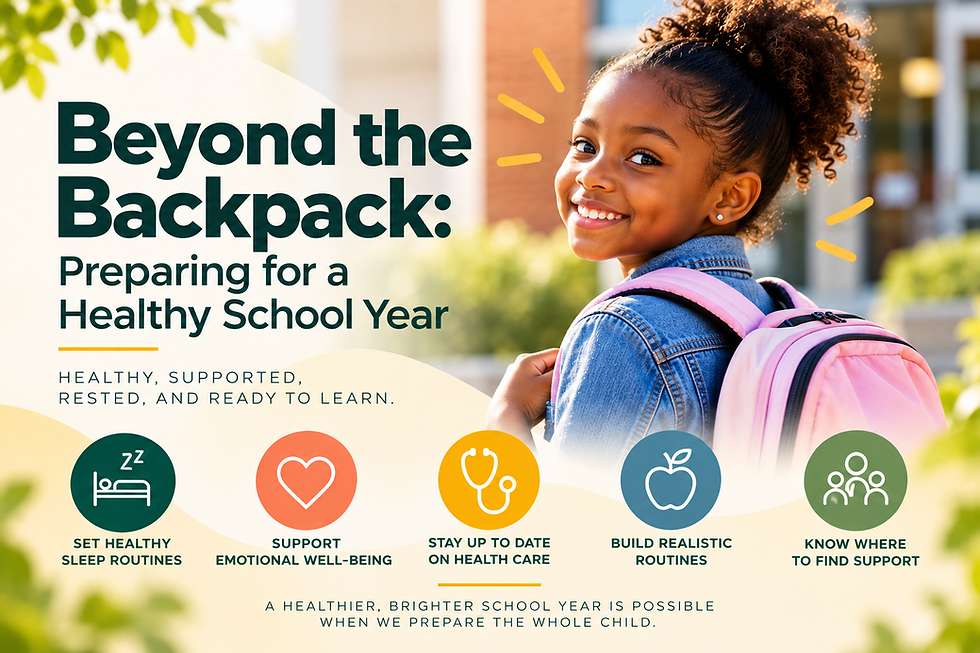
It is also about helping them arrive healthy, rested, emotionally supported, and ready to learn, and helping them stay that way as the year unfolds.
The transition from summer to the school year affects the entire family. Sleep schedules shift. Mornings become busier. Activities resume. Transportation and childcare arrangements change. Families may also be managing school expenses, medical appointments, work schedules, and the emotional adjustment that comes with returning to the classroom.
That makes this season a good time to think about wellness, not as one more thing to add to the list, but as part of how we prepare.
Start With Sleep
Summer schedules have a way of stretching.
Bedtimes get later. Mornings start more slowly. And then suddenly, the alarm clock is ringing before anyone is ready.
Sleep is not simply downtime. Children and teens who do not get enough sleep are at greater risk for attention and behavior problems, poor academic performance, injuries, and mental health challenges (Centers for Disease Control and Prevention [CDC], 2023b). The American Academy of Pediatrics notes that too little sleep can affect memory, concentration, creativity, and learning (American Academy of Pediatrics [AAP], 2025).
Children ages 6–12 need 9–12 hours of sleep every 24 hours, and teens ages 13–18 need 8–10 hours (CDC, 2023b). Yet many students fall short on school nights, especially in middle and high school (CDC, 2023b).
If your household is still adjusting, a few habits can help:
Keep a consistent schedule. Going to bed and waking up at about the same time each day, including weekends, supports healthier sleep (CDC, 2023a).
Power down before bed. Turning off electronic devices at least 30 minutes before bedtime can improve sleep (CDC, 2023a).
Protect the bedroom. Keeping phones, tablets, and other technology out of the bedroom at night can make rest easier (CDC, 2023b).
Build a predictable wind-down routine. A bath, a book, quiet conversation, or evening prayer can signal that the day is coming to a close.
For older children and teens, better sleep may require a conversation rather than simply another rule.
Ask: What is making it hard for you to get enough sleep?
The answer may tell you more than the bedtime itself.
Make Room for the Emotional Transition
Not every child is excited about going back to school.
Some look forward to seeing friends and teachers again. Others may be worried about a new school, academic expectations, making friends, bullying, sports tryouts, fitting in, or simply facing another year.
Sometimes those worries sound like: "I don't want to go."
Sometimes they look like irritability, headaches, stomachaches, trouble sleeping, withdrawal, or changes in behavior.
And sometimes children do not have the words to explain what they are feeling.
That is why one of the most important back-to-school preparations may simply be creating space for conversation. Instead of only asking, "Are you ready for school?" try:
"What are you looking forward to?"
"Is there anything you're worried about?"
"What would make this year feel easier?"
Then listen.
Children do not always need an immediate solution. Sometimes they need to know that the adults around them are paying attention.
Pediatricians encourage parents to watch for warning signs such as struggling in school, sleep problems, or frequent absences, and to keep communication open (AAP, 2025). If anxiety, sadness, changes in behavior, or other concerns begin to interfere with your child's daily life, reach out to your child's pediatrician, school counselor, or another qualified mental health professional.
Don't Forget Preventive Care
The start of the school year is also an opportunity to make sure routine health needs have not been overlooked.
If your child is due for a well-child visit, dental appointment, vision screening, sports physical, or other preventive care, consider scheduling it now, before the calendar fills with conferences, practices, and holiday plans. The AAP recommends annual well-child checkups and keeping immunizations up to date, since shared school spaces make it easier for illnesses to spread (AAP, 2025).
Keeping children on schedule matters for the whole community. The CDC notes that even small declines in vaccination coverage can lead to more cases and outbreaks of vaccine-preventable diseases such as measles (CDC, 2026).
Review your child's immunization record and Maryland's school requirements with your healthcare provider and your child's school. In Maryland, students must have at least one dose of each required vaccine to attend school, and records from another state must meet Maryland's requirements (PGCPS, n.d.-a). The Prince George's County Health Department offers free immunization clinics; call (301) 883-7879 for dates and times.
For children with asthma, diabetes, severe allergies, or other health conditions, confirm that the school has current health information, medication authorizations, and any care plans your child needs. PGCPS provides downloadable forms for parents and prescribers, including the Health Inventory, medication authorization, the Maryland Diabetes Medical Management Plan, and specialized treatment orders (PGCPS, n.d.-c).
Preparation can keep a health need from becoming a school-day emergency.
Build Routines That Can Actually Last
Back-to-school advice often makes weekday mornings sound beautifully organized:
Breakfast at the table. Lunches packed the night before. Everyone dressed on time. Water bottles filled. No one searching for a missing shoe.
Real family life does not always look like that.
Healthy routines do not have to be perfect to be helpful. Start with the ones that make the biggest difference for your household. Maybe that means:
Packing backpacks before bedtime
Identifying two or three quick breakfasts everyone will actually eat
Laying out clothes the night before
Keeping one designated spot for school forms, permission slips, and papers that need attention
Building ten quiet minutes into the evening so everyone has a chance to settle
Routines can nourish the spirit, too. Some families begin the day by saying the Du'a for leaving the home together at the door: Bismillah, tawakkaltu 'ala Allah, wa la hawla wa la quwwata illa billah - "In the name of Allah, I place my trust in Allah, and there is no might nor power except with Allah" (Sunan Abi Dawud, 5095). It takes only a moment, and it gives children a steady, familiar way to begin each school day.
The goal is not a perfect routine. The goal is to reduce unnecessary stress and create a rhythm your family can realistically maintain.
Remember That Back-to-School Has a Cost
There is another part of preparing for school that deserves acknowledgment: it can be expensive.
School supplies. Clothing and shoes. Technology. Transportation. Sports and activity fees. Before- and after-school care. Lunches. Medical appointments.
The costs add up quickly, and they do not end in August.
For families already managing tight household budgets, the school year can create significant financial pressure. Financial wellness is part of overall wellness.
If your family needs support, asking for help is not a failure to prepare. A few places to start:
School meals. Families who may qualify can apply for free or reduced-price meals through PGCPS; there is no cost to students who are eligible (PGCPS, n.d.-d).
Your child's school. Ask the school counselor or front office what resources are available. Sometimes help exists, but families do not know where to look.
211 Maryland. Dial 211, any time of day, to be connected with free, confidential help for food, housing, utilities, child care, health care, and more (Maryland Information Network, n.d.).
Your community. Masajid, faith communities, and local nonprofits may offer school supplies, clothing, meals, transportation support, or other services.
A healthier community is one where people can access the support they need, not one where everyone is expected to manage every challenge alone.
Keep Checking In
The first day of school gets a lot of attention. But the weeks that follow often tell us much more. Once the excitement of new teachers, schedules, clothes, and supplies settles, keep the conversation going. Instead of asking only, "How was school?" try:
"What was the best part of your day?"
"What felt hard today?"
"Who did you spend time with?"
"Did anything happen that you want to talk about?"
"What do you need from me this week?"
These conversations help children understand that wellness is not something we discuss only when something goes wrong.
It is something we pay attention to along the way.
Ready to Learn Means More Than Academically Ready
At The Aafiyah Project, we approach wellness through multiple dimensions (Social • Emotional • Spiritual • Physical • Financial) because each part of our lives influences the others.
Children bring all of those dimensions with them when they walk through the school doors.
A child who is exhausted may struggle to concentrate. A child who is anxious may have difficulty participating. A family under financial stress may be making difficult choices that no one at school can see. A student who feels connected, supported, and cared for may be better equipped to navigate challenges when they come.
The Prophet Muhammad ﷺ said, "Each of you is a shepherd, and each of you is responsible for his flock" (Sahih al-Bukhari, 893). Caring for our children's health and well-being is part of that trust, and it is a responsibility we share as parents, extended family, teachers, and neighbors.
So as we pack lunches, sign forms, and adjust schedules, let us remember what we are really preparing for.
We are preparing children for another year of growing, learning, building relationships, facing challenges, and discovering more about themselves.
Let's make their health and well-being part of that preparation.
Because being ready for school means more than having everything on the supply list. It means helping our children move through the year healthy, supported, rested, connected, and ready to learn.
References
American Academy of Pediatrics Council on School Health. (2025, August 13). 3 ways to help your kids have a healthy school year. HealthyChildren.org. https://www.healthychildren.org/English/ages-stages/teen/school/Pages/back-to-school-tips-to-help-kids-have-a-healthy-year.aspx
Centers for Disease Control and Prevention. (2023a, November 20). About sleep. https://www.cdc.gov/sleep/about/index.html
Centers for Disease Control and Prevention. (2023b, July 18). Sleep and health. CDC Healthy Schools. https://archive.cdc.gov/www_cdc_gov/healthyschools/sleep.htm
Centers for Disease Control and Prevention. (2026, May 4). Routine Immunizations on Schedule for Everyone (RISE). https://www.cdc.gov/vaccines/php/rise/index.html
Maryland Information Network. (n.d.). 211 Maryland. https://211md.org/
Prince George's County Public Schools. (n.d.-a). FAQs [Immunizations]. Office of School Health. https://www.pgcps.org/offices/school-health/immunizations/faqs
Prince George's County Public Schools. (n.d.-b). First day of school. https://www.pgcps.org/about-pgcps/back-to-school/first-day-of-school
Prince George's County Public Schools. (n.d.-c). Health forms for parents and prescribers. Office of School Health. https://www.pgcps.org/offices/school-health/health-forms-for-parents-and-prescribers
Prince George's County Public Schools. (n.d.-d). School meals. https://www.pgcps.org/about-pgcps/back-to-school/school-meals



Comments